The commercial applications of embodied conversational agents are gross.

I have been researching embodied conversational agents for 15+ years and all the commercial applications of this technology are gross. Why did I get into this space? I love video games? I thought the holodeck from Star Trek was cool? In the 2000s, I was working in a lab that specialized in simulated decision-making. Then I met researchers — Alla Safonova and Norm Badler — working in human modeling, animation, and simulation. I thought their work was very cool. Why wouldn’t we simulate people? One of the most interesting (and challenging and rewarding) things about being a person is interacting with other people. How much of our art is about reproducing the human form: in sculpture, dolls, painting, writing, comics, photography, and film. In engineering, the best way to understand something is to try to build it yourself. Of course, we (human beings!) would recreate ourselves in the digital.

The problem is that social agents, unlike artworks, are imaginary friends by design. Sure, Pygmalion fell in love with his own sculpture. But with social agents, they are designed to encourage relationships with us. This fact did not bother me much when I started: in video games, a social agent is like a doll or an avatar for a fictional character. They are not manipulative because the purpose and goals of the agent are transparent and limited to the game. But now that agents are pervasive outside of games, their influence is leaking into the real world. We can keep the dead alive through digital replicas. We can create friends, lovers, and cheap labor. We can now have businesses based on relationships-as-a-service. Yay.

The people — including myself and good friends — that contribute to this technology are earnest: they really wanted to make technology that would be useful to people. The argument goes something like: many people don’t have access to good tutors, doctors, therapists, social workers, etc. What if conversational agents could be cheap alternatives? Then everyone would have access to the best education, medicine, and social services. And by giving chatbots virtual bodies, they can appear more charming, trustworthy, and appealing. But social agents are exactly a solution to the wrong problem. We should be asking why is it so expensive for people to do necessary work? There are 8 billion people on the planet. Why can’t more of these people be doing care work?

Secondly, our virtual relationships are unlikely to be good for us. Social media tries to hack our attention but social agents will try to hack our attachments. Who better than a trusted friend to promote a product or convince us to support a political candidate? Who better to keep us chatting on a platform that friends? Who better to learn all sorts of personal details about us? The potential for addiction, surveillance and manipulation is high.

Third, what happens to our social muscles when we interact primarily with AIs? We would not have to learn patience and generosity. We would not have to develop skills for dealing with difficult emotions — rage, betrayal, disappointment, vulnerability, awkwardness, embarrassment, grief. Our social lives build character and give our lives meaning. A relationship with an AI is a form of self-absorption. Time with AI friends is time we’re not spending out in our communities. If we want to influence how technology is used in our work and living spaces, we need to organize. On the societal level, if AI agents replace civil servants, bankers, engineers, and lawyers, we could lose all accountability for all of society’s functions. An AI agent would be perfect bureaucrat, enforcing every rule with the semantic rigidity of a compiler. Meanwhile, the people who own and control the AI agents don’t have to take responsibility (sorry, those are just the rules).

What would be good social agent technology? To be honest, I am not sure. I’m trying to figure that out.
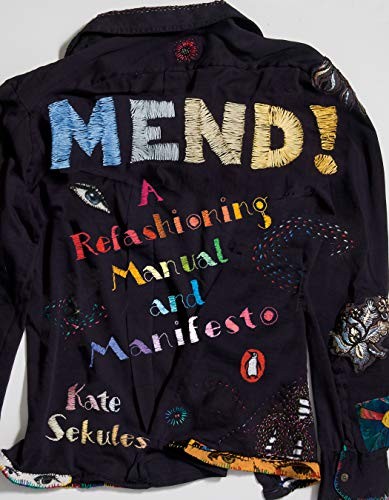
Kate Sekules on the joys of mending

by Aline Normoyle

Give me your tired, your torn, you huddled garments yearning to breathe free, the wretched refuse of your teeming drawer. – Emma Lazarus

Mend! by Kate Sekules is an ode to the joys of slow fashion, letting “clothes become unique to you, a conversation starter, each mend a potential story, like a scar, tied to a story about how the garment became ripped or torn.”

Jacket with embroidery

To be honest, when I was growing up, mending was chore. But when we produce so much waste and are encouraged to buy so much stuff, mending feels subversive. Mending brings us back to a time when crafts were valuable because they were hand-made. Medieval nobility would include garments in their wills. A garment in the 1700s would take nearly have a year to make. Sekules’s book has this account from a girl living in America during the 1790s.

By the 1790s, rural life was still arduous. Elizabeth Fuller, fifteen, of Princeton, Massachusetts, outlined the schedule for making “Pa’s surtout”: Picking wool: three days; breaking the wool: three days; spinning: twenty-four days (by Ma). Then it was sent out to be dyed blue. A woman came in to warp the loom (everyone had one). Elizabeth wove it: two weeks. Then “Mr Deadman” fulled the cloth and Ma cut out and sewed the coat. It took from February to June.

Despite the fact that garments are (artificially) cheap to make, there are many good reasons to mend: the fashion industry is wasteful and exploitative; it makes your style unique and distinctive; it resists commodification and encourages you to have fewer clothes (save money); like veganism and vegetarianism, it can be a protest against an exploitative and wasteful industry; you feel more ownership and agency and meaning when you create the things you use; it’s fun and creative. We often say we take care of the things we love; but it’s impossible not to love the things you care for.

There is a feeling of awe around artifacts of the past that were created with a goal of durability, a desire to last forever. Most garments have not survived, save the occasional 5000 year old dress or the bronze age shirt/skirt outfit of the Egtved Girl. Natural fibers break down unlike metal and stone. But most mass produced garments are created to be disposable (ironically made with petrochemical-based materials that do not biodegrade). Obsolescence means more shopping; it’s part of the business model. Again, from this perspective, mending is subversive. Plus, mending is not hard! From Sekules:

But honestly, there’s only one thought that stops anyone from doing anything, ever, and that is, “I can’t.” But you can mend, even if you’ve never held a needle. Ever since sewing skills melted away, a perception has taken hold that clothes are as impenetrable as a car or an iThing, fixable only by experts—it’s a big reason for our disposable culture.

And she continues:

There were indeed many rules in sewing once upon a time, but we can discount them now. If you like, you can easily stop at the first stitch, running stitch, and still mend for life. Don’t be perfect. Seriously, this is the freest kind of sewing in the world—no wrong way, no pressure, unique fashion item made every time. There’s very little to learn: you practice visible mending by doing it, and in my experience, everyone everyone is always delighted with their very first mend, no exceptions.

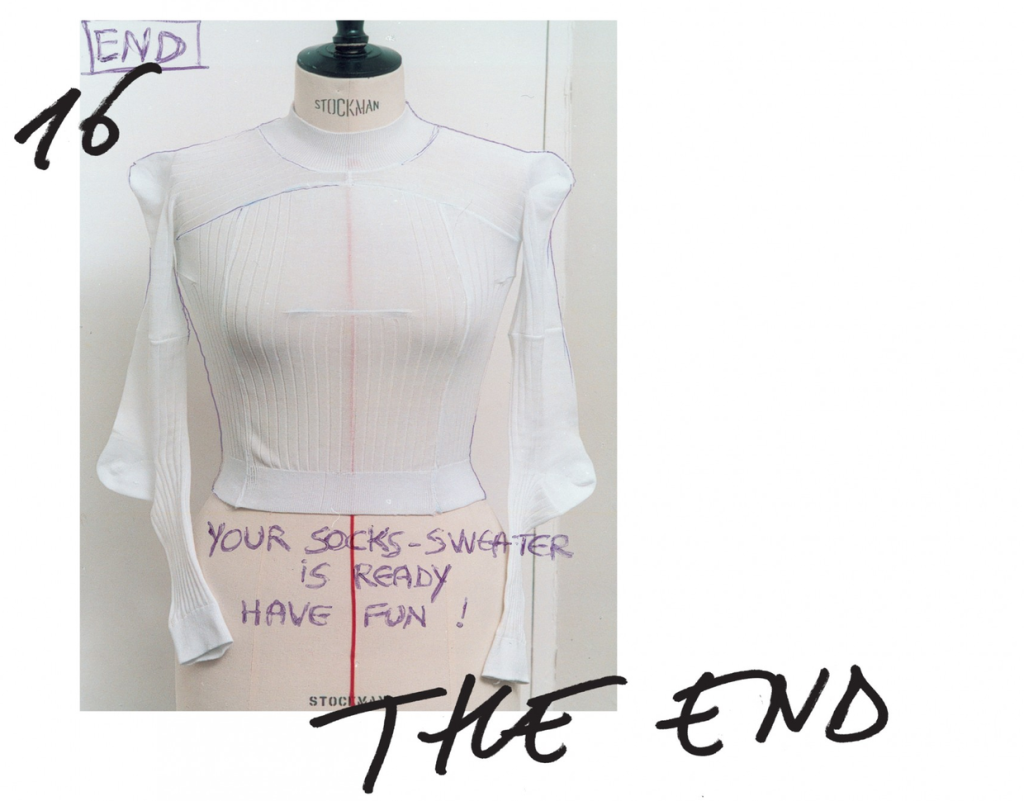
Sekules is an artist of visible mending (VM) in which the mends are artistic statements on the original clothing. The book mentions many creative techniques as well as creative upcycling, and for created re-use of existing clothing, such as the following Margiela pattern for making a sweater from many socks.

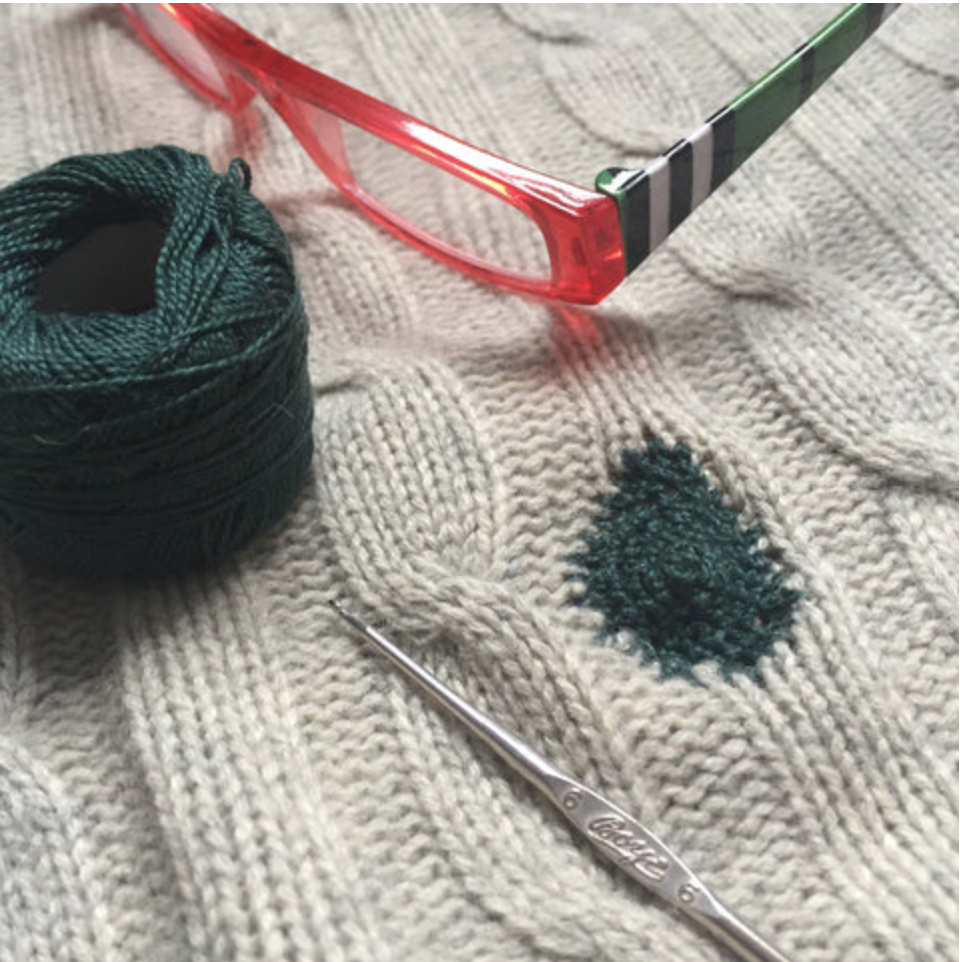
Or this creative crochet mend for a knit sweater from Sekules’s website.

This book makes mending accessible and playful with a repository of stitch types and patch techniques. It includes advice on fabrics (prefer natural fibers like cotton, wool, and linen); washing (to reduce stress on fabrics, spot
clean with white vinegar, cheap vodka, or baking soda to remove stains and smell); storing (discouraging moths).

Repair and maintenance gives a feeling of agency, competency, and connectedness to the real world. Sekules quotes Steven J. Jackson in the following passage.

Repair, wrote information scientist Steven J. Jackson, “is the secret history . . . that has always sustained (but invisibly) the higher profile stories of exploration, empire, and globalization.” His handy phrase “broken world thinking” suggests an upending of our tired old idea that production and innovation are the be-all and end-all. Instead we could conceive of society as a lot of stuff continuously in flux, being broken down and reconstituted, because, as Jackson says, “the world is always breaking; it’s in its nature to break.”1 The fixer knows this. These visible menders live it.”

Slow fashion shows respect to the designers, drivers, dyers, seamstresses, machinists, and so many more who made the garment possible. Slow fashion is a nudge towards a more sustainable society that is more creative and directly engaged in the tools and processes around them.

  1. Jackson, Steven J., ‘Rethinking Repair’, in Tarleton Gillespie, Pablo J. Boczkowski, and Kirsten A. Foot (eds), Media Technologies: Essays on Communication, Materiality, and Society ↩︎