by Aline Normoyle
Programming jobs are presumably disappearing1 but our students are still getting jobs and more broadly, this belief is not supported by the data. In a recent article that analyses data from the U.S. Bureau of Labor Statistics directly, Christine Julien shows that although tech jobs have decreased since COVID, but the total number of jobs is still high.
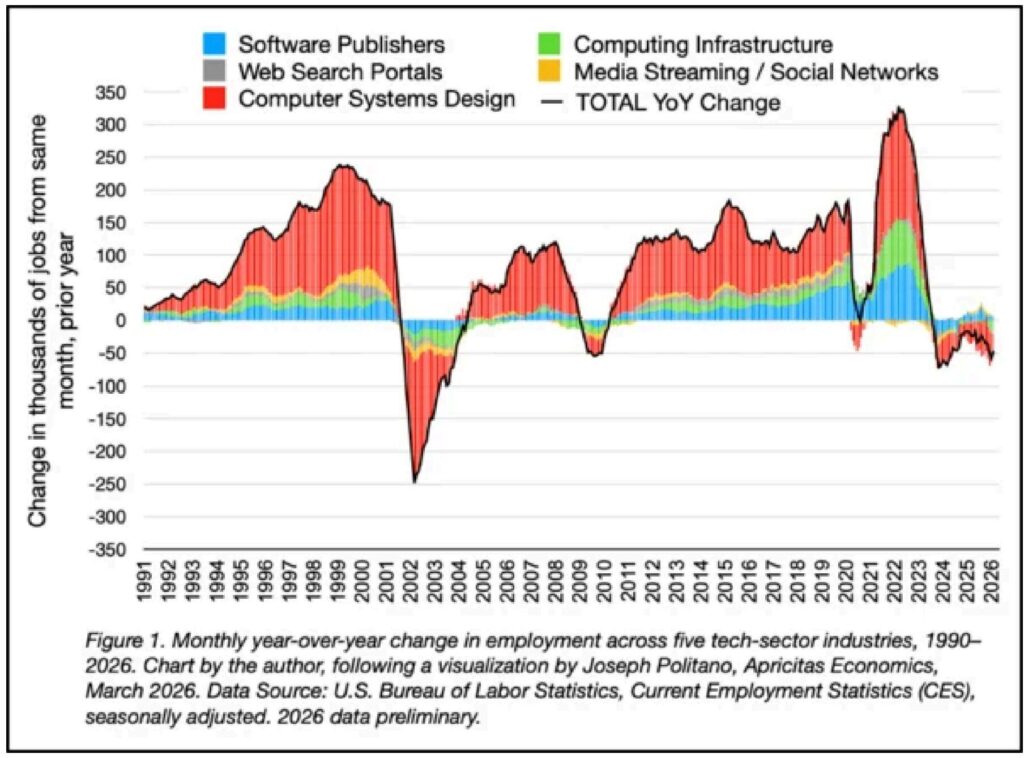
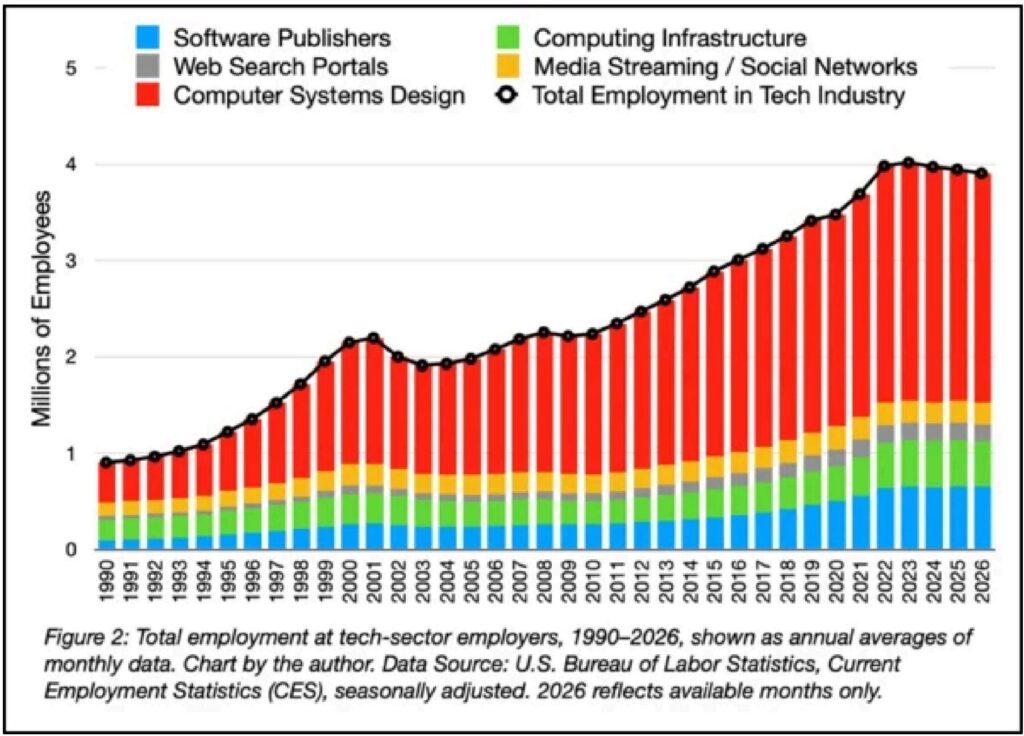
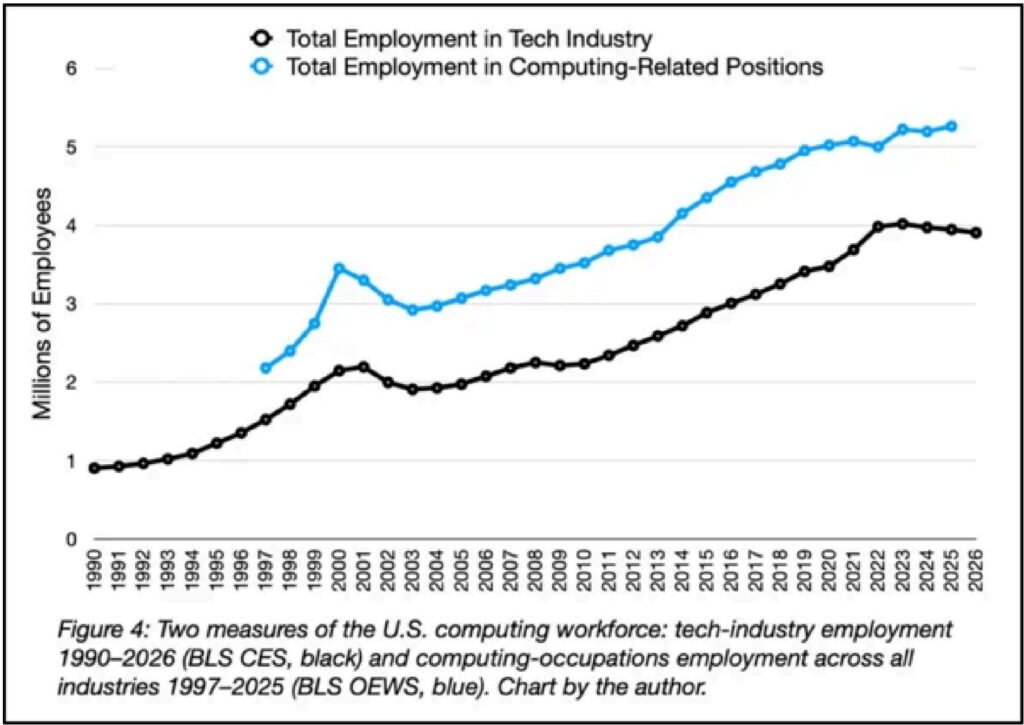
Left, visualization of the change in jobs, compared to the same month in the previous year; Middle, a clearer visualization that shows the total number of jobs which is still high; Right, a visualization comparing tech-related jobs to pure tech jobs. Plots by Christine Julien, Stop saying computer science is dying, Inside Higher Ed, 2026.
Despite this, I wonder if disenfranchisement with computer science might be due to other factors. First, it’s not as easy to get a job straight out of college: there are fewer job openings for junior developers and the major tech companies have been laying people off. The job market also was bad after the dotcom bust and after 2008 crash. Cycles of hiring and firing have been a fact of American employment for decades — typically done as Jack Welch-style2 corporate restructuring aimed at short-term financial gains. We are in a period of cost cutting through minimal hiring. Secondly, the industry has largely abandoned the humanistic ideals from their founding. There may be less excitement about the types of software that is getting investment: it can feel like technology is making people’s lives worse. More expensive, more isolated, more chaotic, busier and more constrained. People want careers that provide meaning and make the world better.
For example, in the case of recent layoffs at id Software, who make Doom, half the studio was laid off despite it being a profitable and critically-acclaimed studio3. Maybe the layoffs are due to AI or to over-staffing during COVID or to changing corporate priorities or as retaliation for unionization attempts. It is impossible to know from official public announcements. Microsoft’s Amy Coleman, Chief People Officer, was careful to say that “the roles eliminated today are not being replaced by AI. At the same time, what is true is that AI is changing how work gets done.”4 The point I want to make is that in recent years, most layoffs are not about productivity and profits, but about the priorities of management. Management is fickle and particularly vulnerable to hype and FOMO.
AI is affecting employment5. Even when it is not directly replacing people, AI still uses investment capital that could be spent on other projects. Although in some cases, it is replacing people. An acquaintance at Comcast says he babysits AIs now, instead of the junior developers. At the recent SIGGRAPH, a movie director talked about how he normally would have to work with others to talk about ideas and storyboard films. When the purpose of the economy is to help strangers cooperate by exchanging goods and services, I don’t see the point. (On the other hand, if the purpose of the economy is to extract value from others’ labor and appropriate their expertise into a commodity that can be placed behind a paywall, it makes complete sense.)
So far, reality hasn’t caught up to upper management yet: AI (read: LLMS) is actually expensive and unreliable; it’s effect of productivity has yet to be shown; and so just like previous rounds of layoffs, I expect companies will start hiring junior developers again. In my 20s, there was a similar push to “outsource” all jobs to places with lower wages: there was still a demand for engineers in North America.
For students deciding what to study, computer science is a demanding subject with a steep learning curve at the beginning. I think it’s a good thing that students are not pursuing majors if they dislike the subject. However, if students do find computer science interesting, I hope they will persist despite our discouraging economic and political moment. Otherwise, we will never achieve the true potential of our computer technology. Technology facilitates storing and sharing knowledge, communication, self-expression, and creativity. I was a CS major because I liked making things and found the work interesting. So let’s not confuse the tech industry (especially Silicon Valley) with technology. Capital has decided the problems that software will solve and how. To rephrase Lewis Mumford: technology is suffering for the sins of capitalism; contrariwise, capitalism is taking credit for the virtues of technology6
And this brings me back to education: computer science education is not — and should never have been — about just getting jobs. Computer science is about understanding the information systems that underlie our society. And what a lot of people don’t realize is that computers are general purpose machines, capable of doing any task that you can express in terms of an algorithm. The hardware is like paper; the software is like writing. We don’t blame literacy when it is used for manipulation and misinformation. But like learning to read and write, understanding our modern technological systems — hardware, algorithms, software design, network architectures, etc — is difficult and formal education and mentorship helps people overcome the challenges of getting started. We do not have the accept a future where all human activity — shopping, communication, art, food — is mediated through their subscription services. But we can’t build this different future without expertise.
My hope is that the industry readjusts after the AI bubble bursts. We start using LLMs as a normal technology: small models that do not rely on exploiting people and destroying the environment. There is a market for software that do not surveil their users; that are reparable; that are customizable; that you can own rather than rent; that use little energy. Energetic, skilled and idealist engineers are needed to build the better technology of the future. Politics change. Politics can force industries to change. Education is part of how we imagine where we want to go and how we might get there.
- For example, Software Engineering Jobs Plummet to 5-year low ↩︎
- To learn more, listen to the podcast episode Jack Welch is why you were laid off, on Behind the Bastards. Jack Welch, who became CEO of GE in 1981, was famous for laying off workers at profitable branches of GE to boost shareholder value. He also popularized “rank and yank” employee practices where the bottom 10% of employees would be fired regardless of job performance. In the 1980s, Jack Welch would transition GE away from making real-world products and towards financial offerings such as loans and insurance. By the 2020s, GE would lose half its value as the financial portions of its business lost value. ↩︎
- Listen to the full conversation at Blood in the Machine, Xbox workers speak out about layoffs. ↩︎
- Read the full press release here. It’s as if Microsoft is trying to say two contradictory things at once: to investors Microsoft wants to signal they are at the forefront of AI while to users, Microsoft wants to signal that these changes are not affecting workers. ↩︎
- But if you would like to read more, I recommend Brian Merchant’s reporting on this topic from his substack Blood in the Machine. ↩︎
- Here is the original quote in context from Technics and Civilization by Lewis Mumford: “Capitalism utilized the machine, not to further social welfare, but to increase private profit: mechanical instruments were used for the aggrandizement of the ruling classes. It was because of capitalism that the handicraft industries of both Europe and other parts of the world were recklessly destroyed, even when the latter were inferior to the thing replaced:for the prestige of improvement and success and power was with the machine, even when it improved nothing, even when technically speaking it was a failure. It was because of the possibilities of profit that the place of the machine was overemphasized and the degree of regimentation push beyond what was necessary to harmony and efficiency. It was because of certain traits in private capitalism that the machine — which was a neutral agent — has often seemed, and in fact has sometimes been, a malicious element in society, careless of human life, indifferent to human interests. The machine has suffered for the sins of capitalism; contrariwise, capitalism has often taken credit for the virtues of the machine.” ↩︎